Kroger Seen as Value Play Amid Thin Margins and Slow Growth Outlook
Kroger
Draws Investor Attention on Buffett Dividend List and Low Valuation
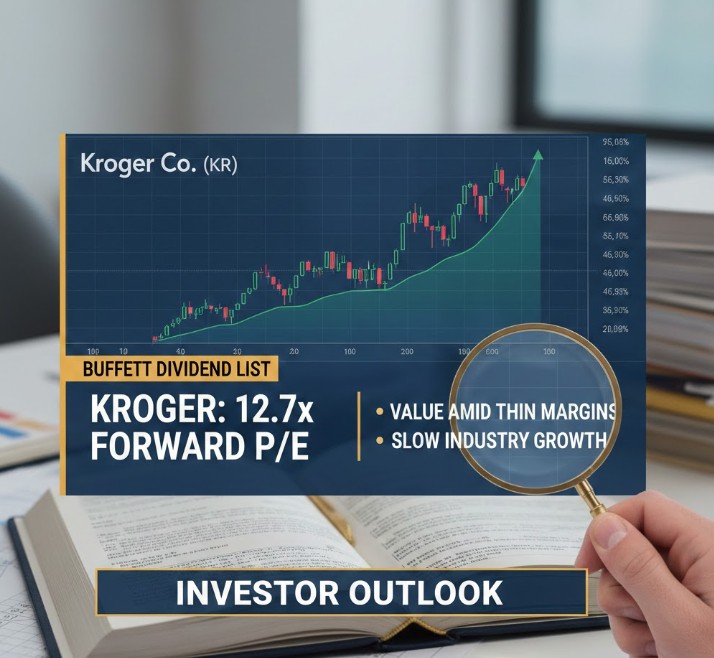
Kroger drew renewed investor attention after
CNBC highlighted the company among 14 “Warren Buffett dividend stocks” and
noted a forward price-to-earnings multiple of just 12.7x. That low valuation,
roughly half the multiple typically assigned to the S&P 500, underscores
why value-oriented investors are weighing Kroger’s subdued growth against its
durable cash flows and dividend profile.
Business
Overview and Industry Dynamics
The Kroger Co. is one of the largest grocery
retailers in the United States, operating supermarkets, multi-department
stores, fuel centers and digital fulfillment services. Grocery is a low-margin,
high-volume business, and Kroger’s scale, loyalty programs and private-label
initiatives give it competitive advantages.
However, the sector faces structural
headwinds, including intense price competition from big-box rivals and
e-commerce entrants. Over the past several quarters, Kroger has navigated
elevated input costs, promotional activity and a slow industry growth environment
that have squeezed margins.
Recent
Performance and Strategic Focus
Kroger’s recent performance reflects this
environment:
- Revenue
continuity driven by steady same-store sales in some periods
- Narrowing
operating margins as the company balances price, promotions and cost
control
Management has focused on:
- Efficiency
measures
- Merchandising
optimization
- Investment
in digital fulfillment
These strategic priorities aim to protect
market share while attempting to restore margin leverage. They also help
explain why long-term investors and income-oriented funds continue to own the
stock despite shorter-term margin pressure.
Immediate
Catalysts
The immediate news driver is twofold:
1. Buffett
Dividend Association
Inclusion on the Buffett dividend list
provides a strong narrative for income and value investors. Being associated
with Buffett’s dividend investing philosophy elevates Kroger’s profile among
conservative portfolios.
2.
Valuation Discount
The reported 12.7x forward earnings multiple
signals a material valuation discount versus the broader market. This prompts
comparisons of potential upside if Kroger can stabilize margins or if the
multiple re-rates.
Why the
Discount Exists
The valuation discount is not without reason.
Grocery retailers typically trade at compressed multiples because of:
- Low
organic growth
- Capital
intensity required to defend market share
Kroger faces additional pressures from:
- Persistent
wage inflation in retail labor markets
- Freight
and input-cost variability
- Promotional
intensity needed to retain shoppers in price-sensitive categories
Any easing of inflation helps gross margins.
However, sustainable margin expansion requires execution on assortment
strategy, supply chain productivity and digital fulfillment economics.
Operational
Investments: Opportunity and Risk
Kroger’s capital deployment into:
- Automation
of fulfillment centers
- Loyalty-driven
personalized promotions
- Private-label
expansion
These initiatives can lift long-term margins
but carry upfront costs and uncertain near-term returns.
For investors, the key question is whether
Kroger’s low multiple sufficiently prices in execution risk and industry
stagnation, or if the market is over-penalizing a company with steady cash
generation and a commitment to shareholder returns.
Market
Reaction and Analyst View
Market reaction to the CNBC note and valuation
framing was measured. Value-focused funds and dividend-seeking investors have
historically been attracted to Kroger when its multiple contracts. However,
broader market participants remain cautious given the slow-growth nature of
grocery retail.
Analysts typically emphasize:
- Margin
trajectory
- Same-store
sales trends
Firms covering the space point to execution on
cost controls and the pace of price deflation as primary determinants of
near-term earnings revisions.
Several sell-side analysts highlight the
tug-of-war facing Kroger:
- Improving
supply-chain efficiencies and private-label growth could catalyze a
re-rating
- Prolonged
promotional activity or renewed input-cost inflation would keep multiples
depressed
Independent strategists note that the dividend
profile and cash flow stability make Kroger suitable for income allocations,
while recommending close monitoring of capital expenditures and the margin
contribution from digital and fulfillment initiatives.
Investor
Takeaways
The implications for investors are clear:
- Valuation
Appeal
A forward P/E of 12.7x appears attractive, but valuation alone is not a sufficient buy signal. Confirmation of margin stabilization or early signs of recovery improves the risk-reward profile. - Dividend
Sustainability
Income-oriented investors should assess dividend yield relative to payout sustainability. Steady free cash flow supports dividends, but heavy reinvestment into fulfillment or price support could pressure near-term cash flow. - Staged
Entry Approach
Active investors may prefer accumulating shares on confirmed improvements in operating margins or positive revisions to same-store sales, rather than relying solely on valuation.
Risk
Factors and Potential Catalysts
Key Risks
- Commodity
cost trends
- Wage
pressures
- Competitive
pricing dynamics from large retailers and regional grocers
Potential
Upside Catalysts
- Better-than-expected
margin guidance
- Faster
realization of fulfillment efficiencies
- Strategic
initiatives that meaningfully differentiate Kroger’s cost structure or
customer proposition
Conclusion
Kroger presents a classic
value-versus-structure investment case. The company’s 12.7x forward P/E and
inclusion on a Buffett dividend list make it attractive to conservative,
income-focused investors. However, thin margins and sluggish industry growth justify
the market’s cautious stance.
For long-term investors, the decision hinges
on conviction in Kroger’s ability to convert operational investments into
durable margin expansion and sustain cash returns to shareholders. For
shorter-term traders, signs of margin stabilization and earnings revisions
remain the critical triggers for a potential re-rating.
The stock drew renewed buying interest after CNBC included Kroger on a Buffett dividend list and highlighted its low 12.7x forward P/E, flagging it as an undervalued income play despite ongoing margin pressures.