JPMorgan Didn’t Become America’s Strongest Bank by Accident. The Numbers Explain Why.
Everyone talks about trends. AI. Tech. Crypto.
But the biggest money in the market often flows toward something far less exciting.
Consistency.
And no company represents that better right now than JPMorgan Chase.
At first glance, JPM looks like just another large bank. But once you look at the numbers, a very different story appears.
Start With the Scale
JPMorgan is the largest bank in the United States, with more than $4 trillion in assets.
That alone changes how it operates.
It touches nearly every part of the economy: consumer banking, credit cards, corporate lending, investment banking, asset management, and global markets.
When the economy slows, JPM absorbs shocks.
When it recovers, JPM accelerates.
That balance is rare.
The Pullback That Mattered
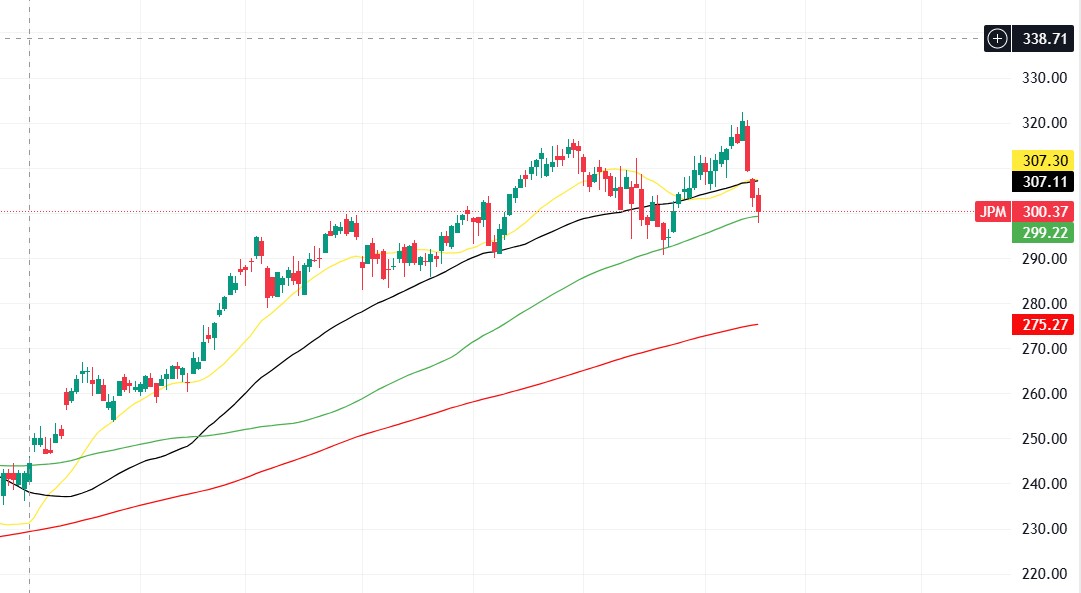
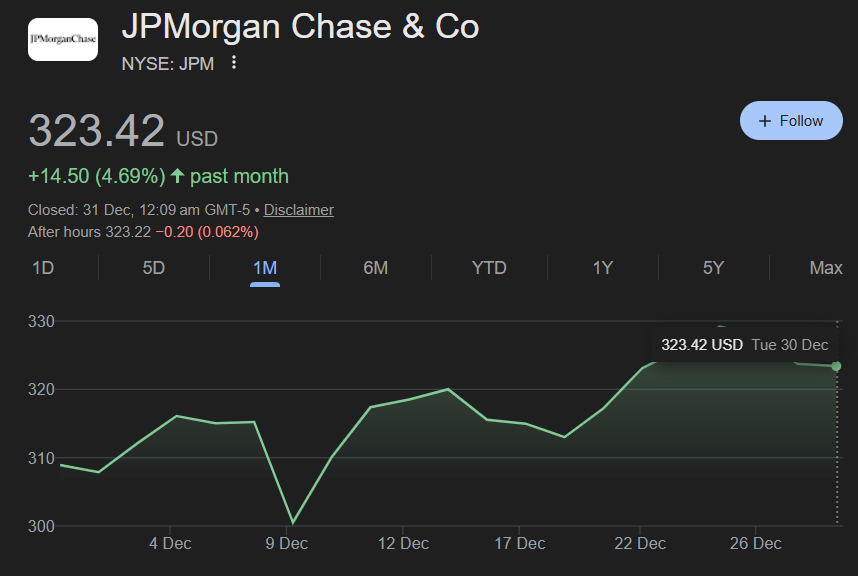
Recently, JPM pulled back to around $295, aligning almost perfectly with its 100-day moving average.
This level has acted as support multiple times during past uptrends. Each time JPM tested it and held, the stock eventually moved higher.
This time was no different.
The bounce wasn’t driven by hype. It was driven by institutional buying. The kind of buying that doesn’t chase tops but accumulates strength.
Profitability That Others Can’t Match
In the most recent fiscal year, JPM generated over $49 billion in net income.
To put that in perspective, many banks would consider $5 billion a strong year.
JPM also continues to post industry-leading return on equity, even during periods of rate uncertainty and regulatory pressure.
This is what separates JPM from its peers. It doesn’t need perfect conditions to perform well.
Capital Markets Are Waking Up Again
For much of the past year, investment banking activity was muted.
That’s changing.
Deal activity is gradually returning. Equity and debt issuance are improving. Trading desks are seeing healthier volumes.
JPM benefits more from this than any other U.S. bank because it dominates across investment banking, trading, and asset management.
As capital markets normalize, JPM’s fee-based revenue grows alongside it.
AI at JPM Is Not a Buzzword
JPMorgan spends over $15 billion annually on technology, with a growing share focused on AI.
This includes fraud detection, automated risk modeling, trading algorithms, and customer personalization.
These systems reduce losses, cut operating costs, and improve efficiency at scale.
For a bank of JPM’s size, even small efficiency gains translate into billions over time.
The Chart Confirms the Story
From a technical perspective, JPM continues to form higher lows on the weekly chart.
Momentum indicators moved from overbought back into neutral territory without breaking structure. That’s typically what strong stocks do before resuming their trend.
A sustained move above the $305–308 zone could open the door toward $330–350 over the medium term if macro conditions remain supportive.
This Is Not a Momentum Trade
JPM is not the stock that doubles in a year.
It’s the stock that compounds.
It pays a dividend. It protects capital. It grows alongside the economy rather than betting against it.
And that’s exactly why large institutions continue to hold it as a core position.
The Takeaway
JPMorgan Chase isn’t exciting because it promises the future.
It’s powerful because it already owns the present.
With massive scale, strong profitability, improving market conditions, disciplined risk management, and a chart that signals accumulation rather than weakness, JPM remains one of the most dependable stocks in the market today.
Sometimes, the smartest move isn’t chasing the next big thing.
It’s recognizing the strength that’s already there.
Disclaimer
This article is for educational and informational purposes only. It is not investment advice. Always consult a qualified financial advisor before making investment decisions.